
Piha Surf
The locals' version of what the break is, what to expect, and what to respect. The ultimate training ground.
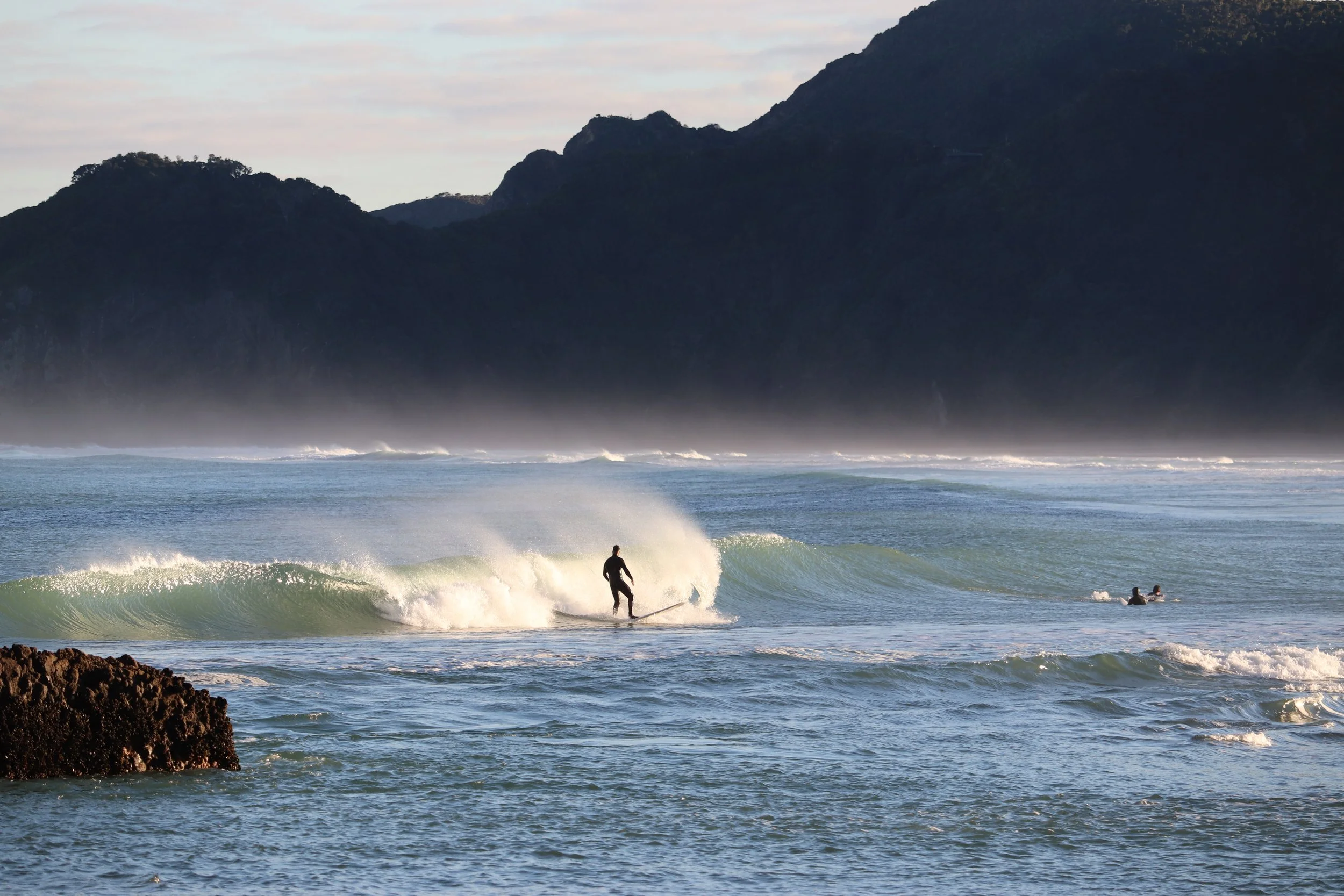
A lot of New Zealand surf culture developed here — the country's first surf lifesaving club at Piha was established before most of the world had heard of board riding, and Piha has been producing serious surfers continuously since. Part of the reason is the conditions: inconsistent, punchy, fast, and heavy. You can't just learn one wave and ride it forever; you have to learn to read the ocean. Surfers who grow up at Piha tend to be confident in conditions that intimidate people who learned somewhere gentler.
You can surf most days, but that doesn’t mean you’ll always score.
Piha is an exposed west coast beach break facing the Tasman. This means it picks up swell almost continuously. There's almost always something to surf here. The downside of the same fact: the sand is always moving. We can have big swells that roll through and either make or break a wave you were surfing last week. While we do have some ‘consistent’ spots like The Cove, the swells influence the quality of the wave all year round. If you're learning, the right answer is almost always to take a lesson with one of the four local schools — they read the conditions for you and choose where and when to put you in the water. If you're an experienced surfer visiting from elsewhere, plan to watch the break for a while before you paddle out.
Different zones = different personalities.
North Piha is the most exposed with sandbanks constantly shifting from the swells. Generally, unless there is a good bank, North Piha won't really be working if it is over 3ft. On a small day with waves 1-3ft, spots light up right along the beach and you will be sure to find a wave. If you are learning, 2 hours before high tide and light winds will work in your favour. A nice stiff easterly wind can produce some pumping waves at North Piha, especially by the stream. It will attract a big crowd. Luckily it is a long stretch of coast so everyone is quite spread out amongst the peaks. A couple hours either side of the high tide is a safe bet but when it is small enough you can usually surf right through. Spots to check would be the north side of Lion Rock, Helipad, Monkey Rock and Caves.
Consider North Piha best for surfers intermediate and up, unless it is so small that the south side of Piha is flat (believe it or not we do get this a couple weeks out of the year!)
Piha is the more sheltered bay. Camel and Lion Rock help to provide protection from the swells and wind and you can often find it about a foot smaller than North Piha. Because of the headlands this side of Piha can handle more size than North.
The Cove - is at the southern end of Piha. This wave is great for learners, groms or anyone looking to catch a wave. When it is working (because remember, we are dealing with constant moving sand) a nice mellow right hander runs along the camel rock rip. If you happen to really score it, you can catch a wave right to the sand then take the rip right back out. The Cove is quite forgiving and works on the higher tide. It can handle most conditions but doesn’t like a NW swell and a strong NW wind. This spot gets very crowded especially in summer.
Mid Beach - There is a peak that works well when it is 1-3ft. Can handle it bigger if there is a good bank. Breaks left and right but the right has the longest ride. Can be quite punchy with good sections. More exposed than The Cove and better for more intermediate to experienced surfers.
The Bar - When the bar is working you can find a world class left hander. The problem is these days the bar is pretty elusive. Low to mid tide is favoured. The Bar will bring a big local crowd along with a pecking order. Be sure to know the rules and have good wave reading. Experience and confidence are essential.
Conditions.
Tide. 2 hours either side of the high tide is the general rule here, with a few swell size exceptions.
Wind. East or Southeast for offshore conditions. Piha can handle onshore winds if it is not too strong. Consider the wind direction and headlands that can provide some shelter.
Swell Direction. Southwest (SW) or West Southwest (WSW)
Best Time of Year: Autumn and Winter.
Use the rip, don’t fight it.
If you don't know where the rip is, don't paddle out.
Surfers at Piha actually use the rips. They function as conveyor belts to paddle out — the same current that pulls swimmers into trouble pushes a surfer through the breakers without having to fight every wave. Knowing where the rip is, and how to use it, is a meaningful piece of local skill.
The line locals use to teach this:
"The rip is your friend… until it's not."
Which translates to: the rip is a tool when you understand it, and a hazard when you don't. If you find yourself in a tricky situation, don’t be afraid to raise your hand and call for help. A lot of surfers are happy to get you to safety and often can respond faster than the lifeguards.
Surf etiquette.
A few principles worth knowing.
These are some simple commonsense surf etiquette rules that apply to basically every break.
Don't paddle straight into the main peak. It's how you make enemies, and it's how someone gets hurt. Watch the line-up first, find where you fit, and start there.
Watch for a while before you go in. Even ten or fifteen minutes from the beach tells you a lot — where the sets are landing, where the rips are running, who's surfing where, what the rotation is.
Don’t drop in. Always try to check over your shoulder before you take off, that there isn’t someone in a better position paddling for the wave or worse, a surfer already riding the wave. Accidents happen though, just be sure to acknowledge and apologise and people are usually pretty sweet.
Respect that locals know the banks and rips better. They've been here longer, they've watched the break in more conditions. Listening to a local steer you toward or away from a particular spot is usually wise.
If in doubt, don’t go out.
The deeper truth.
Piha isn't just a surf spot. It's a training ground.
A lot of New Zealand surf culture developed here — the country's first surf lifesaving club at Piha was established before most of the world had heard of board riding, and Piha has been producing serious surfers continuously since. Part of the reason is the conditions: inconsistent, punchy, fast, and heavy. You can't just learn one wave and ride it forever; you have to learn to read the ocean. Surfers who grow up at Piha tend to be confident in conditions that intimidate people who learned somewhere gentler.
For visitors, the implication is twofold. First: you're surfing in a place with real surf heritage, and the line-up tends to reflect that. Approach the break with the appropriate respect and the locals are generous to a fault. Second: if you're learning here, you're learning at a place that genuinely teaches. The skills you build at Piha — reading water, working with rips, choosing your moments — translate to almost any beach in the world. Most beaches are simpler than Piha. None are more honest.
New to Surfing?
Get lessons from locals.
If you're learning to surf at Piha, take a lesson with a local school. What you're paying for in a lesson isn't just the surfing instruction. It's someone who reads the water for you, chooses the right corner of the right end on the right day, and puts you somewhere you can actually learn.
Piha Surf School - 0275812812 or zen@pihasurfschool.com
Piha Surf Academy - 021661082 or surf@pihasurfacademy.com
Piha Surf Shop & Camping - (09) 8128723 or pihasurf@xtra.co.nz
Lion Rock Surf Shop - (09) 8128422 or pop in, they are right next to the Piha Store
Independent instructors — A handful of qualified local instructors operate one-on-one outside the named schools. The right answer if you want a fully private lesson or you've been recommended to a specific instructor by someone you trust.
Finally, Piha offers some great waves for all levels. It attracts most Aucklanders for a reason! The dangers are very real but as long as you have some general etiquette, common sense and try your best to read the waves, you will have a good time. For learners - start at The Cove and work your way north as your surfing progresses. For seasoned surfers - pick your windows and spots. Some days will give you some epic waves on a longer board and others will require something shorter to make the quick takeoff. The black sand can seriously burn your feet in the summer, bring jandals and don’t forget the SPF!!
